

How Journaling Finally Quieted My Mental Chatter
Lois Radians
Journaling turned out to be one of the simplest ways I have found to quiet mental chatter, break out of repetitive thought loops, and give my brain somewhere safe to “file” what it’s been carrying all day. When you look at the science, there is decent evidence that structured writing can modestly improve mood, anxiety, and stress, especially as an add-on to other care.
Why I Mocked Journaling For Years
For decades, I quietly rolled my eyes at the idea of keeping a journal.
It felt self-indulgent and vague, more like something teenage me would have done with a lockable diary than something adult me, juggling work, bills, and responsibilities, should waste time on.
When people talked about “journaling for mental health,” I assumed it was just another self-help fad that sounded good but didn’t actually move the needle.
What Changed – The First Time I Really Tried It
What finally pushed me to try journaling was not inspiration, but exhaustion.
My head felt like a crowded room where ten different conversations were happening at once – worries about money, unfinished tasks, old resentments, future plans, and random bits of dialogue I never actually said out loud.
One evening, I got fed up with listening to that internal noise and decided to just write down everything swirling in my mind, without editing or trying to make it pretty.
I filled page after page with fragmented thoughts, half-sentences, lists, and complaints.
When I closed the notebook, something surprising happened: the chatter did not disappear completely, but it dropped from a roar to a low hum.
For the first time in a long time, I felt like my mind had a little space around the edges.
How Putting Thoughts On Paper Clears Mental Chatter
Here is the simple, practical shift I noticed: when my thoughts stayed in my head, they bounced around in circles and kept triggering each other.
Once I captured them in words on paper, they became objects I could see, move around, and even ignore for a while.
Writing turned vague mental noise into specific sentences that my brain could start to organize, instead of endlessly replaying.
Psychologists often talk about “expressive writing” – writing about one’s deepest thoughts and feelings related to stressful experiences – as a way to turn raw, emotional material into a more coherent story.
When you do that, you are effectively taking unstructured mental chatter and giving it a beginning, middle, and end, which seems to make it easier for the brain to tuck it away instead of constantly revisiting it.
What The Research Actually Says About Journaling And Mental Health
My subjective experience is one thing, but I also wanted to know if journaling is more than just placebo.
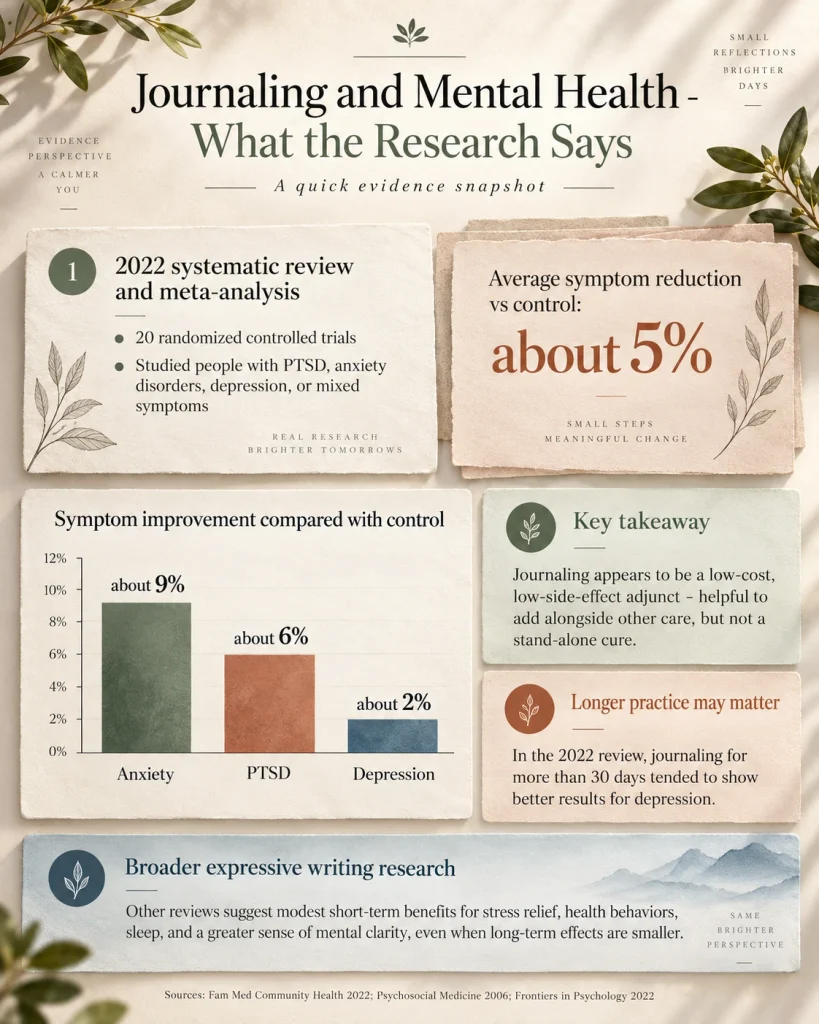
A 2022 systematic review and meta-analysis looked at 20 randomized controlled trials where journaling was used with people dealing with PTSD, anxiety disorders, depression, or combinations of those.
Across these studies, journaling led to an average 5 percent greater reduction in mental health symptom scores compared with control groups, with bigger benefits for anxiety and PTSD than for depression.
In that review, anxiety symptoms improved by roughly 9 percent and PTSD symptoms by about 6 percent compared with controls, while depression showed a smaller 2 percent improvement.
The authors concluded that journaling is a low-cost, low-side-effect adjunct – something that can reasonably be added to standard treatments, even though it is not a stand-alone cure.
They also noted that longer interventions (more than 30 days of journaling) tended to produce better results for depression, which matches the intuitive sense that emotional habits take time to shift.
Another large body of work focuses on “expressive writing” in healthy and clinical populations.
Early meta-analyses reported medium-sized benefits for physical health, psychological well-being, and physiological functioning when people wrote about traumatic or deeply stressful events over several short sessions.
Participants who wrote honestly about their experiences often reported fewer stress-related doctor visits, improved mood, and a greater sense of psychological well-being in the months after writing.
More recent analyses, however, have been more cautious.
A 2006 meta-analysis of 30 randomized trials concluded that expressive writing had minor or no long-term effects on overall physical or psychological health, though it found a small benefit for health behaviors such as sleep and medical visits.
Another study on college students found that expressive writing produced short-term reductions in depression symptoms at two months, but those benefits did not clearly persist at later follow-ups.
Taken together, the research paints a nuanced picture: writing is not magic, but it can offer modest, reliable help, especially for anxiety, stress, and short-term relief, and it is safe and inexpensive enough to be worth trying.
If you want to read some of the actual research, here are a few key papers:
Journaling systematic review and meta-analysis (Fam Med Community Health, 2022): https://pmc.ncbi.nlm.nih.gov/articles/PMC8935176/
Meta-analysis of expressive writing and health (Psychosoc Med, 2006): https://pmc.ncbi.nlm.nih.gov/articles/PMC2736499/
Forty-year overview of expressive writing research (Frontiers in Psychology, 2022): https://www.frontiersin.org/journals/psychology/articles/10.3389/fpsyg.2022.825626/full
Journaling, Rumination, And Mental Loops
One of the most exhausting parts of anxiety or low mood is rumination – that repetitive mental loop where you chew on the same problem or memory without resolving it.
Several reviews of journaling and expressive writing note that these interventions tend to help most with anxiety and trauma-related symptoms, which often involve intrusive thoughts and mental replay.
By forcing you to articulate the loop in concrete language, journaling can interrupt the cycle: you stop carrying a fuzzy cloud of worry and instead face a specific paragraph or page you have already written.
An evidence summary that synthesizes multiple meta-analyses reports that journaling produces small but statistically significant improvements in anxiety and PTSD, with less consistent effects on depression.
It also notes that weekly or otherwise sustainable writing often works better than intense daily writing that people quickly abandon, which aligns with the idea that steady, gentle processing beats sporadic emotional dumping.
This matches what I have felt personally: when I journal regularly, the mental loops weaken faster than when I only write during crises.
Physical Health And Stress – Beyond The Mind
Several classic studies in this area looked not just at feelings, but at physical health markers.
In early expressive writing experiments, participants who wrote about traumatic experiences in a meaningful way showed things like fewer stress-related doctor visits, improved immune function, reduced blood pressure, and better self-reported physical health over the following months.
Later meta-analyses found that these physical health effects were generally small, but still detectable, especially in healthier populations.
For people with significant medical conditions, like cancer, expressive writing has been studied as a brief supportive tool.
A 2015 meta-analysis in breast cancer patients found that expressive writing using emotional or benefit-finding prompts reduced negative physical symptoms in the short term, though the effect did not clearly persist beyond three months and psychological outcomes did not differ much from controls.
Again, the pattern is modest but encouraging: writing seems to help people manage stress and physical discomfort for a while, even if it does not radically change long-term disease trajectories.
Why Journaling Works Even When The Evidence Is Modest
When I look at the research, I do not see journaling as a miracle treatment; I see it as a simple way to give the mind and body a healthier workflow.
Writing externalizes what is otherwise stuck in working memory, which frees up mental bandwidth and can reduce the sense of being mentally “cluttered,” even if clinical scores only move a few points.
Over time, that uncluttering can make it easier to sleep, to focus on tasks, and to be present with other people, which are meaningful quality-of-life gains even if they are hard to capture in a single questionnaire.
The studies also quietly highlight some useful rules of thumb: journal for more than a few days if you want deeper benefits, aim for honesty instead of perfection, and do not worry about anyone reading what you write.
In fact, one meta-regression found that journaling worked better when entries were not collected or analyzed, suggesting that privacy and freedom from judgment are part of the mechanism.
So the “messy notebook you never show anyone” style of journaling may actually be closer to the optimal scientific protocol than the beautifully curated public journal.
How I Journal Now To Stop Mental Dialogues
My own practice looks nothing like the tidy, Pinterest-worthy journaling spreads I used to imagine.
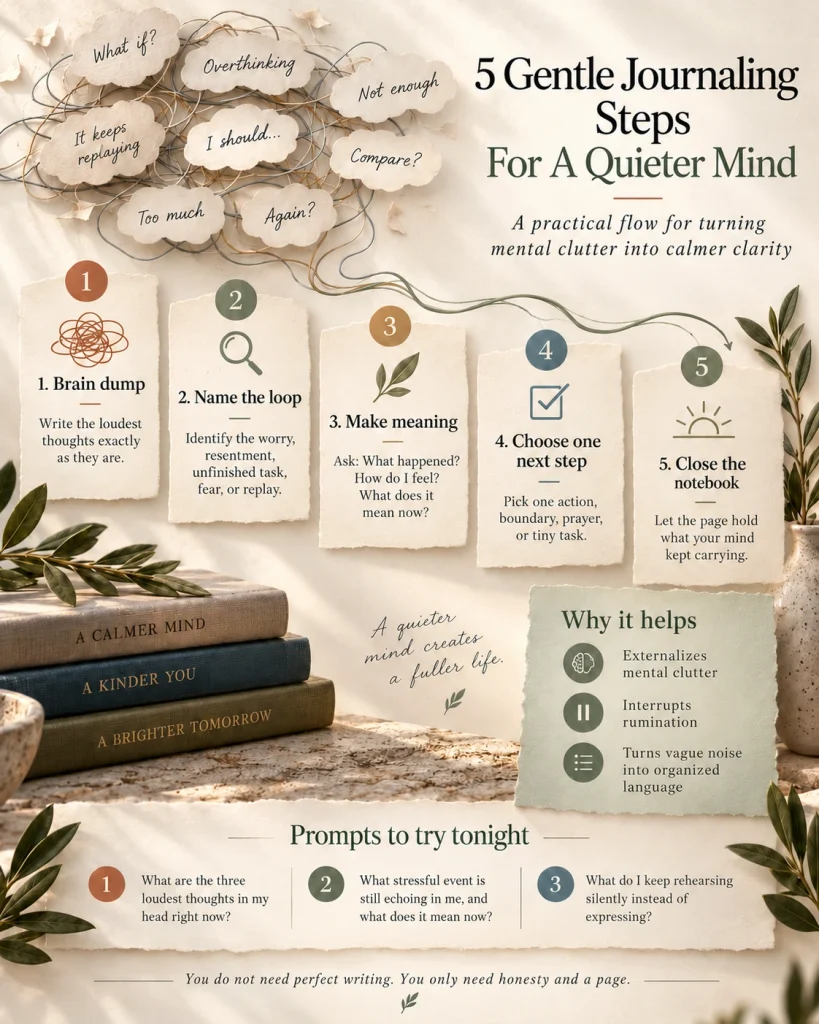
Most days, I start with a raw “brain dump” where I write whatever is loudest in my mind – worries, ideas, resentments, half-finished to-do lists – without trying to be wise or inspirational.
Once that initial clutter is on the page, I naturally shift into a second phase where I start connecting the dots: why a particular worry is bothering me, what pattern keeps showing up, and what one small action I could take next.
Sometimes I write long, unfiltered paragraphs about a painful memory or current stressor; other times I just jot down three lines about what feels heavy that day.
The key is that I treat the journal as a workspace, not a performance: it is where unfinished thoughts are allowed to be unfinished, where I can say the things I was replaying but never saying out loud.
By the time I close the notebook, the mental dialogue has usually settled into something quieter and more organized, even if nothing “big” has changed in my life.
Simple Prompts To Try Tonight
If the idea of staring at a blank page feels intimidating, here are a few straightforward prompts that mirror what research trials often ask people to do:
“Right now, what are the three loudest worries or thoughts in my head, and what do they actually sound like in words?”
“Think of a stressful or painful event that is still echoing in my mind – what happened, how did I feel, and what does it mean to me now?”
“What do I most wish I could say, to myself or someone else, that I keep rehearsing silently instead of expressing?”
You do not have to show these pages to anyone.
You do not have to write every day.
But if you give yourself twenty minutes, a pen, and the permission to be honest, you may notice that your mind feels less crowded afterward.
Browse Guided Journals And Workbooks
If you would like more structure than a blank notebook, guided journals and workbooks can offer prompts, reflection questions, and gentle frameworks that make the process easier to stick with.
I have poured a lot of my own learning about mental chatter, reflection, and spiritual and practical inner work into the journals and workbooks in my Peace Springs Publishing catalog.
You can browse those journal and workbook collections here: https://peacespringspublishing.com/shop/ and choose the format that best fits how you want to write, reflect, and finally give your thoughts a calmer home.